One client stays one security boundary
Each of your clients gets its own Gateway — an AAG security boundary holding that client’s credentials, permissions, policy and audit history. Nothing is shared between them by default.

How it works
AAG sits on the access path between your team’s AI and your clients’ systems. Every request runs inside exactly one client’s boundary, and leaves a record.
In four steps
A person on your team starts a session for one client. The session belongs to that client’s gateway.
Client AThe client’s gateway checks the session and the permission for the exact request. Anything else is refused.
AllowedThe client’s connector uses the client’s credential to run the request. The AI gets the result, not the credential.
Credential stays putThe decision is recorded against that client: who acted, what was asked, allowed or refused, and when.
RecordedContext and control
Explore the design concepts behind client context, permitted requests and reviewable answers. Confirm the capabilities for your workflow during pilot scoping.
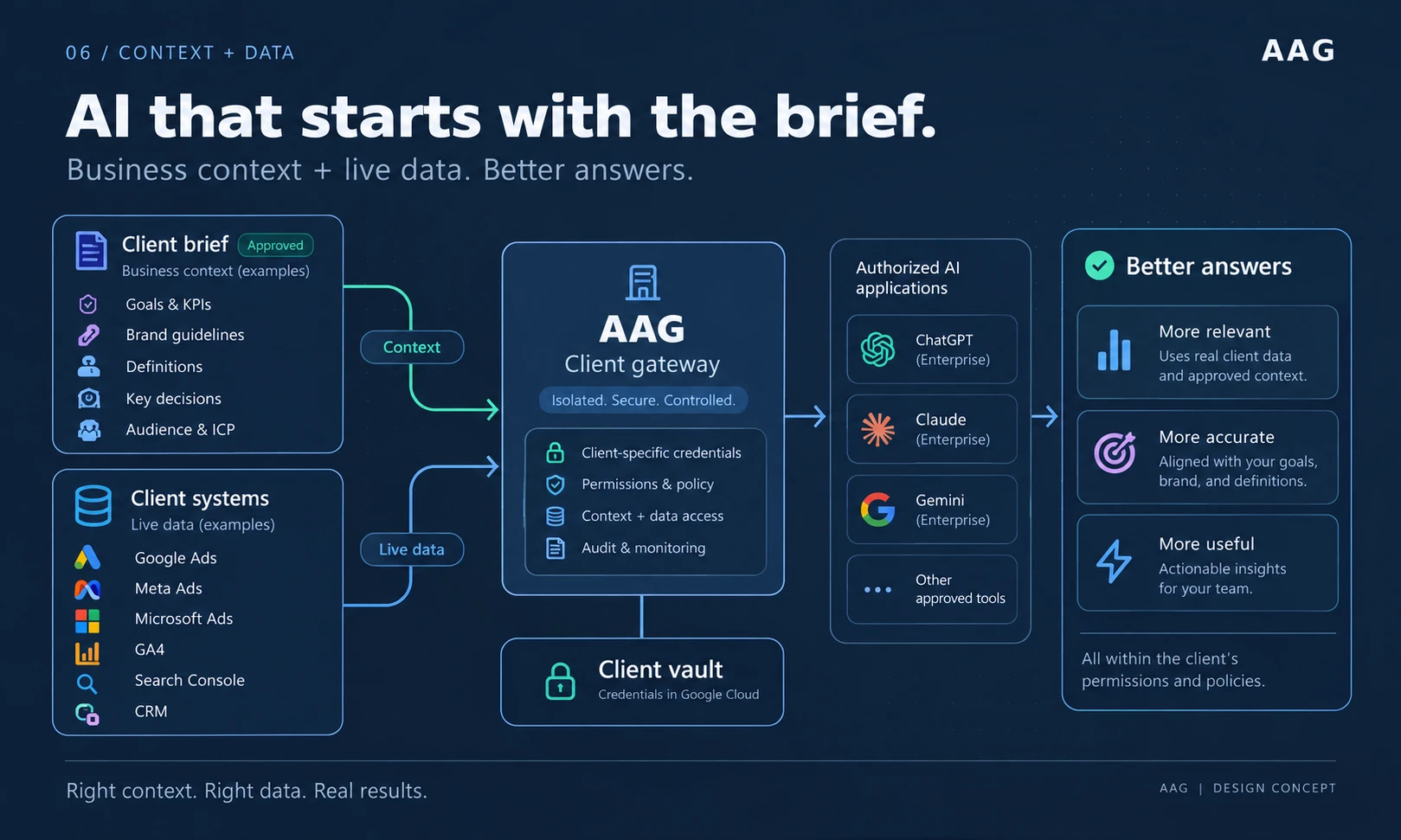
Bring client goals, brand guidance and definitions together with authorized system data. The diagram shows a client gateway providing that context to an AI application while protecting credentials in the client vault.
The benefits shown are intended outcomes; review generated answers against source data. Confirm the named connectors, AI applications and brief-management features in your pilot scope. Check availability →
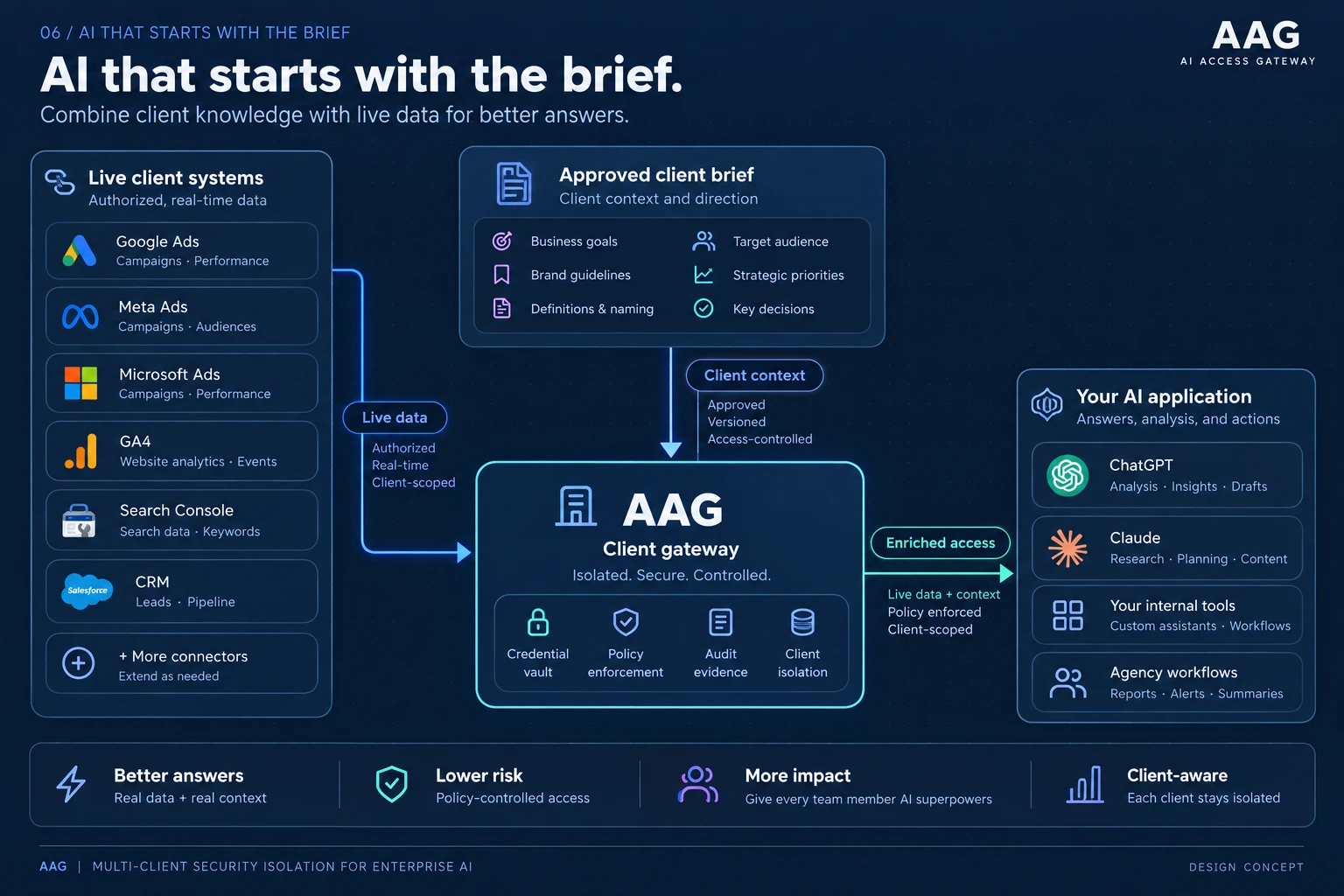
The expanded view groups client goals, brand guidance and key decisions with authorized system data, then shows potential uses by AI applications and agency workflows.
Expanded design concept. Named providers, real-time data, brief versioning and workflows are not an availability guarantee; confirm each requirement during scoping.
 View expanded illustration full size ↗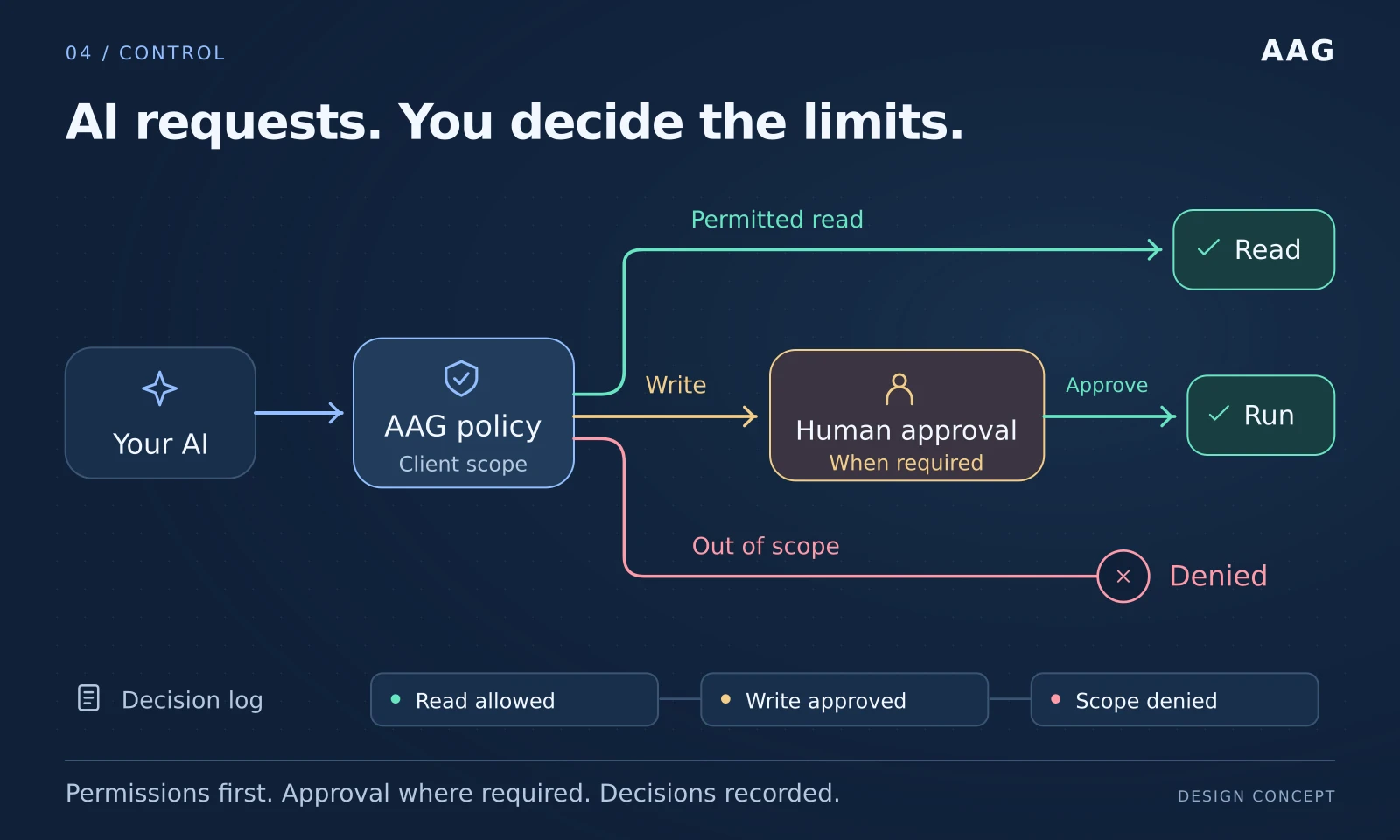
The client policy determines the permitted operation. A workflow can require human approval for a proposed change, while out-of-scope requests are refused. The decision is recorded.
Conceptual approval workflow. Current reviewed connector evidence covers read-only Google Ads operations; write and approval support require separate verification. Review available operations →
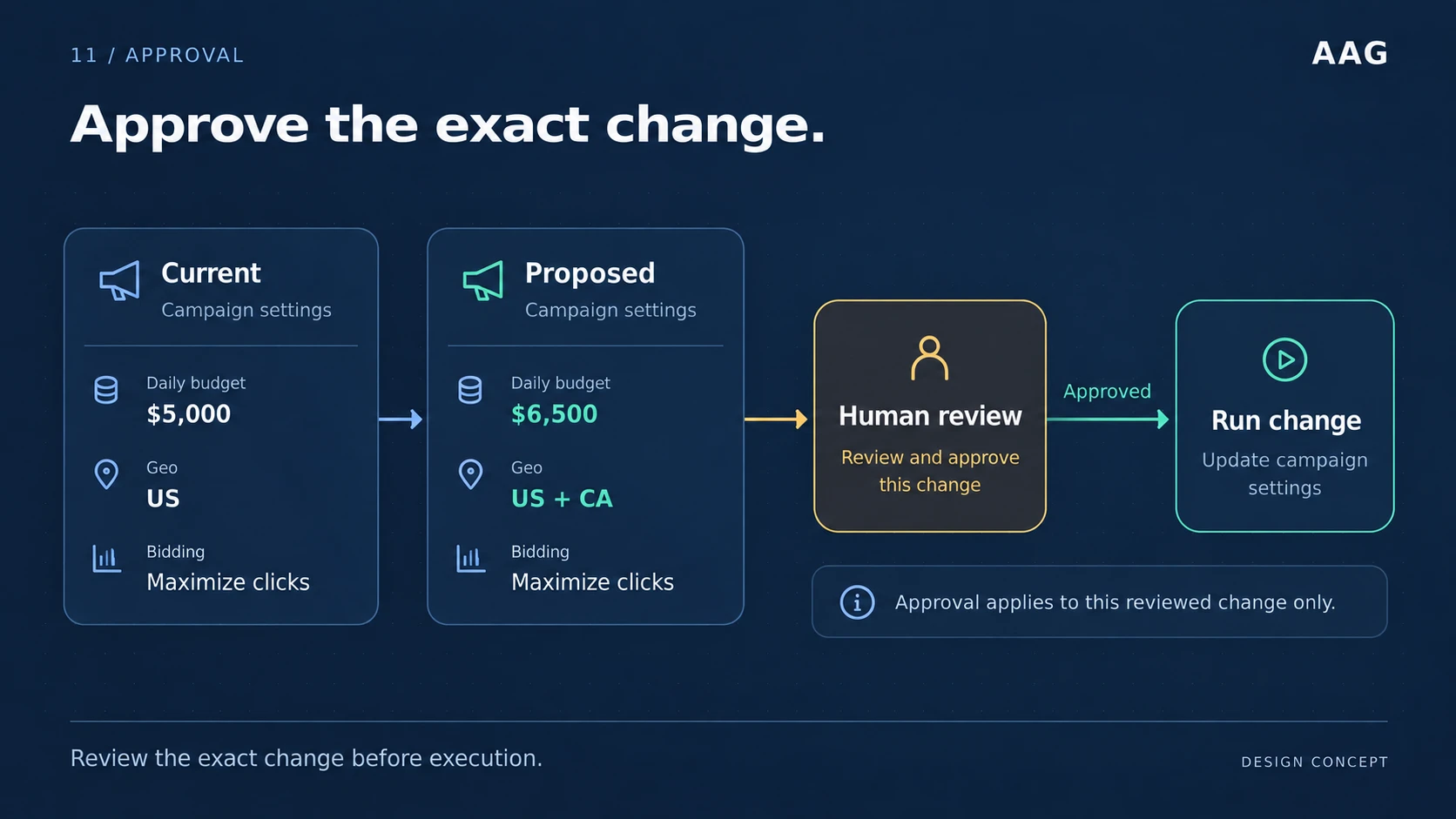
The example compares the current and proposed budget and geography while keeping the bidding strategy unchanged. Approval applies only to the reviewed change.
Synthetic campaign settings, not AAG prices or an available campaign-editing feature. Write operations and approval enforcement must be verified for the chosen connector. Check operation availability →
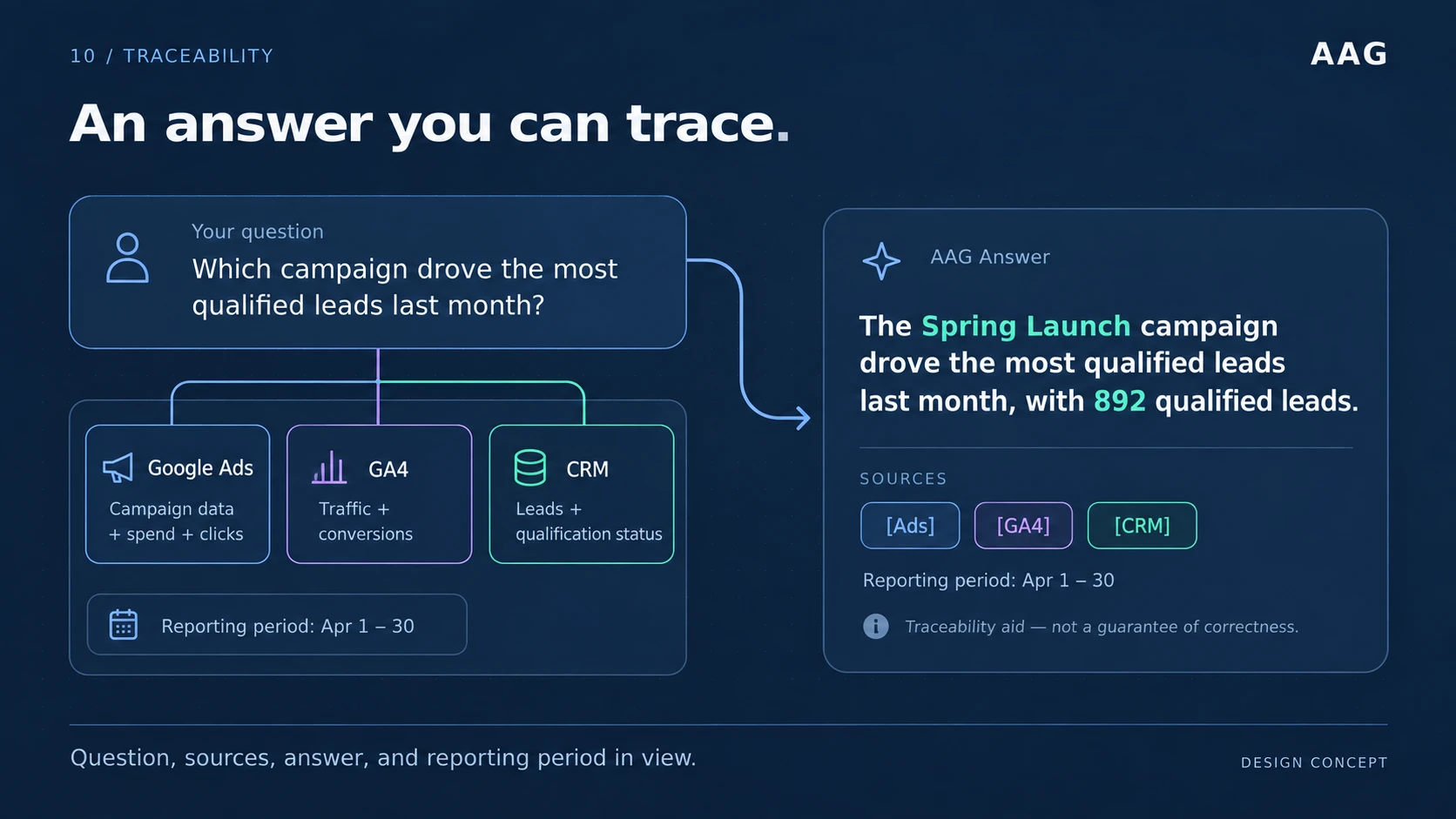
A useful answer makes its question, sources and reporting period visible. In this synthetic example, a named campaign is reported as the leading source of qualified leads.
Illustrative answer format, not an actual AAG response. Source references help review an answer; they do not establish its correctness or replace the gateway’s access-decision record. Review audit evidence →
In detail
Each of your clients becomes an Agency Client with its own Gateway — an AAG security boundary. Nothing crosses between them unless you deliberately make it so.
A client’s provider credential is submitted through a single-use intake and stored encrypted with a dedicated gateway encryption key. The control plane holds metadata about it, not the secret itself.
Your team member authenticates and receives a revocable AAG session bound to one Gateway — one client boundary — and no other.
The AI does not ask for a credential. It asks to perform a specific operation against a specific client system, under the authority of its session. Gateways speak MCP, the Model Context Protocol.
The gateway checks permissions and policy against that exact operation. If the session, Gateway and client do not line up, or the policy does not permit it, the request is refused before anything reaches the provider.
A permitted operation runs in that client’s connector executor, which is the only component able to read that client’s credential. The AI receives the result, not the key.
The time, the client boundary, who acted, the operation, the allow-or-deny decision and the result are recorded in a hash-chained audit record.
Suspend or destroy a gateway, or rotate or revoke a credential. After committed revocation propagates, subsequent requests are refused; already-admitted requests can finish. The record is kept.
Each of your clients gets its own Gateway — an AAG security boundary holding that client’s credentials, permissions, policy and audit history. Nothing is shared between them by default.
AI does not receive raw provider credentials. Credential material stays behind the protected execution path; the AI is authorized to perform a specific operation instead of being handed the key that performs it.
An AI Session is issued against a single client boundary. The gateway checks that binding on every request rather than assuming it.
Permission and policy are evaluated against the exact intended operation before anything touches a downstream provider — not logged after the fact.
A mismatch between session, Gateway and client is a refusal, not a warning. The safe outcome is the default outcome.
Each decision records who or what acted, in which client boundary, which operation, the allow-or-deny outcome, and when.
Suspend, retire and destroy a gateway; rotate or revoke a credential; disable or re-enable a connector. Losing a client is as operationally real as winning one.
The security model binds to authenticated AI principals and governed capability execution, not to one model vendor. Switching models does not mean rebuilding your client boundaries.
If an AI session is compromised or behaves unexpectedly, it is designed to be limited to one client’s boundary rather than everything the agency can reach.
A pilot runs one real workflow with real credentials, so you can check these properties yourself.